

Agree the ground truth first.
The professional defines missing, incomplete, irrelevant and disputed evidence before evaluation. Record the starting checklist, claim complexity and available sources.
Measure the work, not the payout.
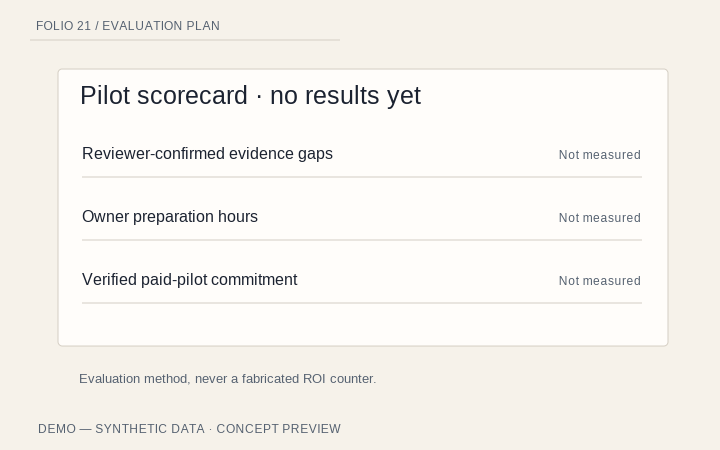
Compare reviewer-confirmed evidence gaps and owner preparation hours before and after review. Separate active work from waiting, professional work and correction time.
- Missing-item count and severity, with denominators
- False-positive flags, omissions and reviewer corrections
- A scoped paid commitment independent of claim outcome
- Actual repeat referrals and channel economics
Go only through the pilot gates.
Jurisdiction/licensing and referral review; written consent and agreed handling; a supervising professional; selected offer; signed bounded paid scope. Results are not yet available.
Evidence maturity and open risks.
The brief rates evidence high for policy complexity and insurer workflows, and low for insured-side demand and outcome impact. Acquisition is episodic. Jurisdiction licensing, channel economics and actual repeat-referral rate remain open research gaps. A useful packet or referral intention does not establish repeat demand.
Stop or re-scope when the boundary fails.
Halt activities requiring an unavailable license, unlawful access, unsafe handling or material professional-boundary uncertainty. Repeated critical omissions or payout-contingent-only demand would also stop expansion.