
Gather. Review. Approve a draft.
Gather and link the evidence. Review the questions and assumptions. Let the owner approve a current draft.

 CONCEPT PREVIEW · NOT AN OPERATING PRODUCT
A draft stays a draft
until reviewed.
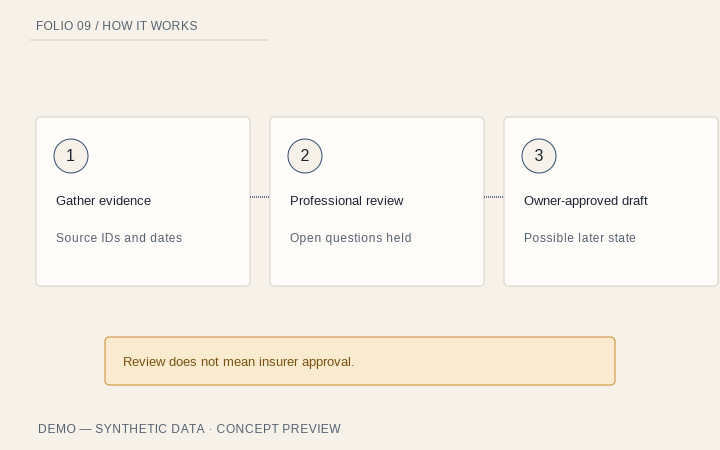
Gather the sources. Ask the questions. Your supervising professional reviews the evidence, addresses open assumptions and helps you finalize a complete draft.
Follow the workflowYour evidence
Source documents
PH-01 · Kitchen photo
R-09 · Repair invoice
P-08 · Payroll summary
Photos, invoices, payroll and revenue records, connected to dated facts.
Professional review
Open questions
Reopening evidence missing
Expense treatment unresolved
Insurer determination —
Source-linked questions, visible gaps and assumptions that can be challenged.
Owner-approved draft
Possible next stage
Alder Oven · CL-14
Evidence packet · DRAFT
Not submitted
The owner approves the reviewed version, with unresolved issues still disclosed.
Reviewed ≠ covered. Approved draft ≠ submitted. No external action occurs in this preview.
Every question
has a source.
Link each question to the documents that support your claim. Keep your facts, dates and assumptions organized in one place.
Explore policy questionsHearthline Repair
Repair invoice · R-0918 FEB 2026What supports the repair invoice and its payment?
to decisions, together.
Change the draft.
Refresh the review.
Source dates and assumptions remain editable. A change creates a new version and invalidates affected review and owner approval. The reviewer may return a draft, reject a suggestion or review with unresolved issues disclosed.
Let’s start with
a useful question.
Would document preparation be worth paying for, independent of the claim outcome?
Timeline & evidence
One redacted property/BI packet.
One supervising professional.
A reviewable, bounded scope.
written consent and a paid agreement.